Extreme Heat & The Built Environment
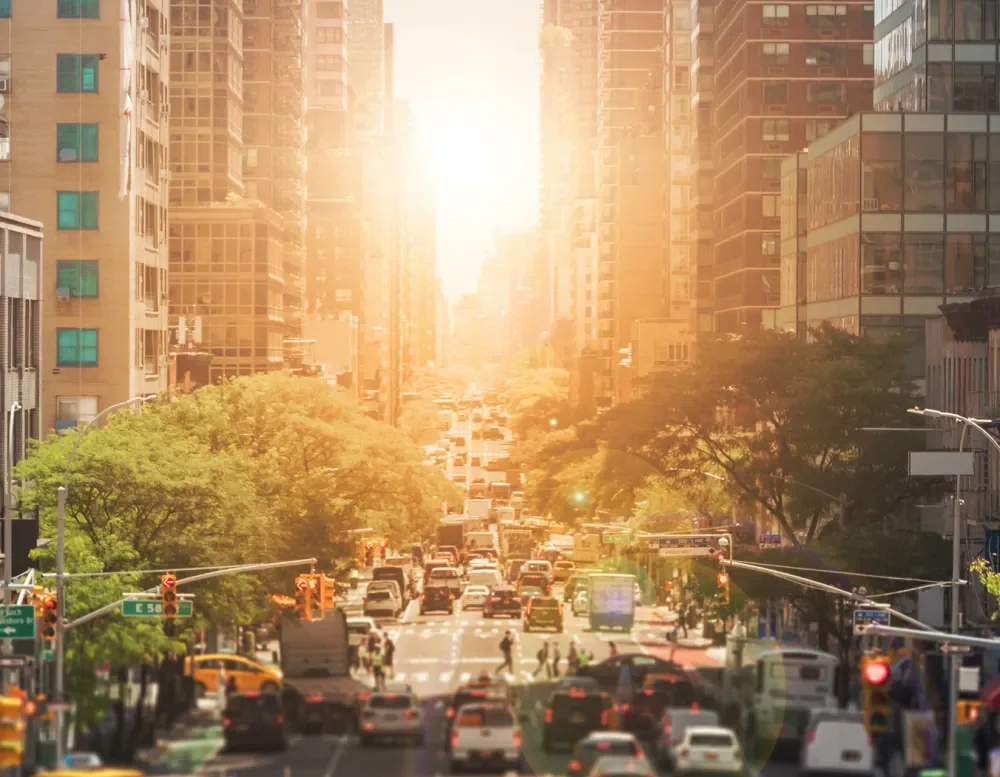
Image Credit: Arbor Day Foundation
Cities are hot. With dense populations and an abundance of buildings and paved surfaces, urban areas consistently have higher daytime and nighttime temperatures than neighboring rural areas. This phenomenon is referred to as the Urban Heat Island (UHI) effect and is a direct result of the built environment within a city.
One of the places in which this has been clear for a long time is New York City. As far back as 1896, officials in New York City recognized heat as a serious public health hazard when an extended heatwave in the city killed more than 1500 city residents. The 1896 heatwave was so severe that it spurred then-mayoral candidate Theodore Roosevelt to petition for the free distribution of ice to the city’s poorest residents, marking some of the first efforts to protect vulnerable populations from the extreme heat of the city.
Even without extended heatwaves, summertime in New York and other cities has historically been hot, sticky, and uncomfortable. Before the advent of electricity and air conditioning, many New York City residents (at least those who could afford to) packed up and fled the summer heat, flocking to cooler, more rural areas, particularly in the Adirondack Mountains. With fewer buildings and more natural surroundings like forests and lakes, the Adirondacks provided relief from the sweltering city heat. In fact, it was this annual summer exodus that made the Adirondacks one of the first major vacation destinations for early 20th century New Yorkers.
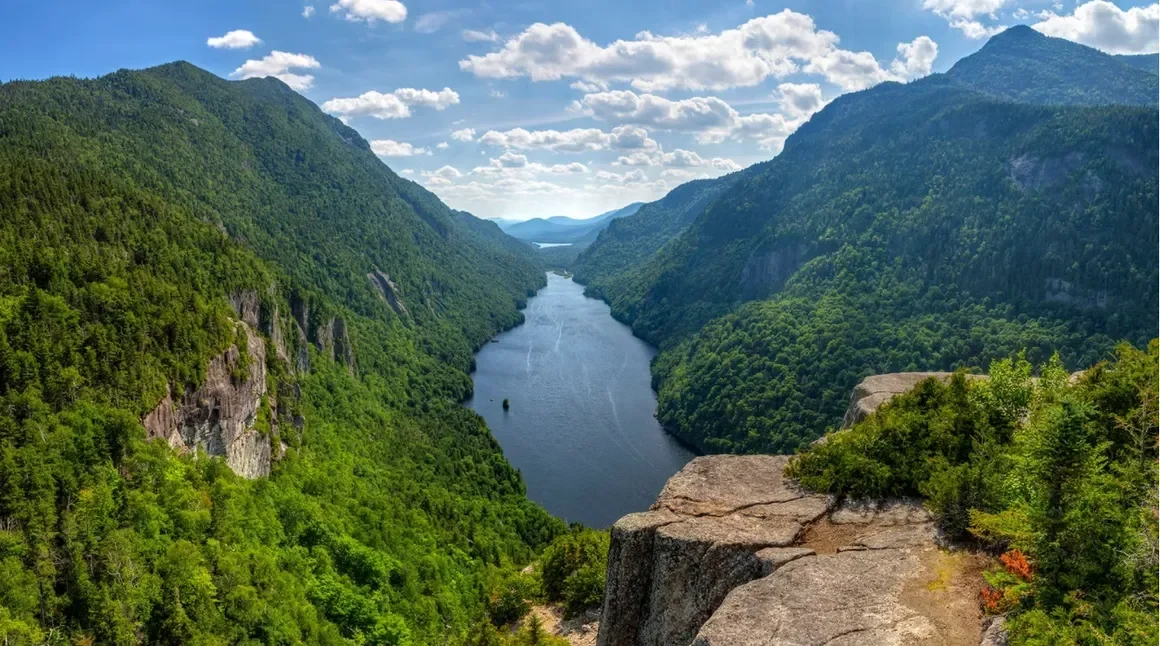
Photo Credit: lightphoto/Getty Images
While modern-day city dwellers can turn to air conditioning or city-sponsored cooling centers to escape the heat, cities themselves continue to be hot spots in comparison to more rural areas, and they are only getting hotter. So, what is it about cities that make them so much warmer than rural areas?
The Built Environment
The main reason that cities experience higher temperatures than their rural counterparts is due to their built environment. Quite simply, the “built environment” refers to human-made structures like buildings and pavement. Although buildings, roadways, and parking lots can be found in rural areas as well as urban ones, it is the sheer number of these structures that are present in cities that contribute to higher urban temperatures.
Cities typically have numerous large building complexes and closely packed buildings along with miles and miles of impervious paved surfaces like roads and parking lots. These structures transform solar energy into heat, absorbing and trapping energy from the sun during the day and then releasing that energy back into the environment as heat during the night. As a result, temperatures in cities can range anywhere from 0.9 °F to 7.2 °F higher in the daytime and 1.8 °F to 4.5 °F higher at night than neighboring suburban or rural communities, turning cities into their own “heat islands” amongst a sea of lower temperatures.
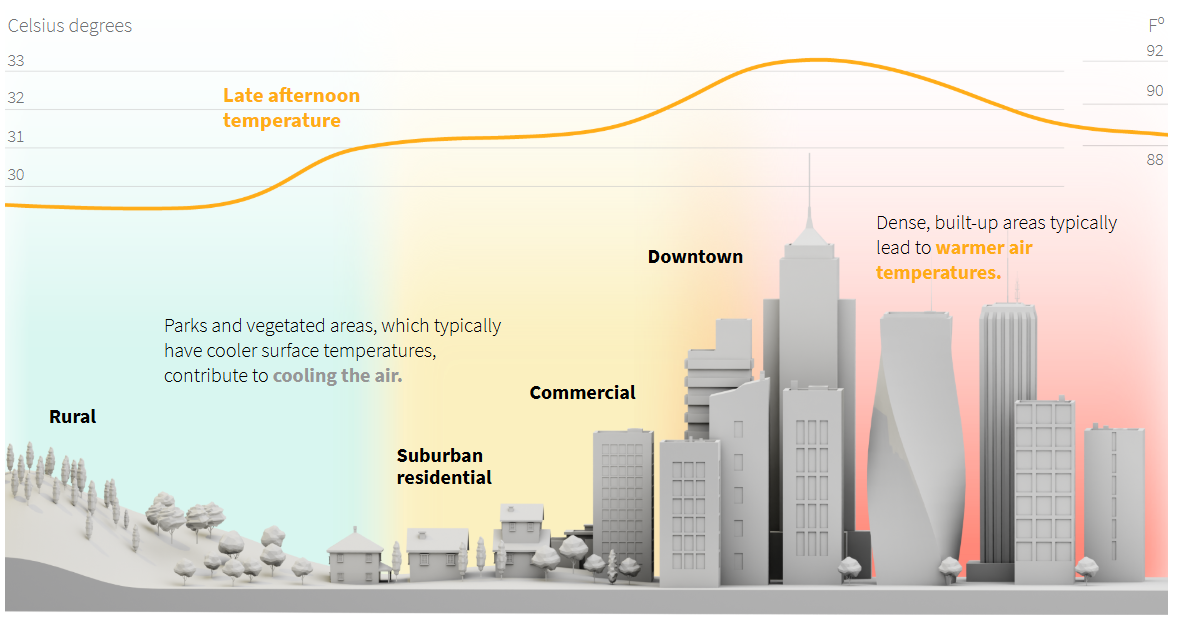
Image Credit: Reuters
It is not only an abundance of human-made structures that contributes to higher city temperatures – it is also the design of the buildings, the building materials used, the building codes and zoning standards that dictate what can be built and where, the history of redlining and the financial investment (or disinvestment) in the area, and other developmental choices that are made during the planning and design phases.
Building Design
Most modern buildings are designed without windows that can be opened, instead relying on complex and energy-intensive HVAC systems to maintain comfortable temperatures and provide adequate ventilation throughout the structure. This requires a huge amount of energy to be consumed within cities – energy that is then released by these buildings into the surrounding area as heat. The outsized dependence on HVAC systems ends up creating a heating loop of sorts, in which rising temperatures lead to greater air conditioning use which leads to the release of more heat into the atmosphere, which then contributes to higher temperatures, more air conditioning usage, and more heat released into the surrounding environment.
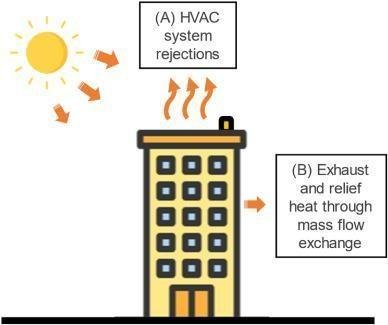
Image Credit: EESM
Building Materials
There are several commonly used building materials in cities that contribute to higher temperatures and exacerbate the Urban Heat Island effect. Roadways, parking lots, sidewalks, and other urban structures are frequently made from concrete or asphalt. Unlike grass or soil which are permeable and absorb less solar energy, concrete and asphalt are impermeable and have been shown to absorb nearly 95% of the sun’s energy. When exposed to direct sunlight for an extended period, these surfaces can get as hot as 180 °F, leading to burns if touched and elevating the surrounding temperature as absorbed heat is radiated back into the environment.
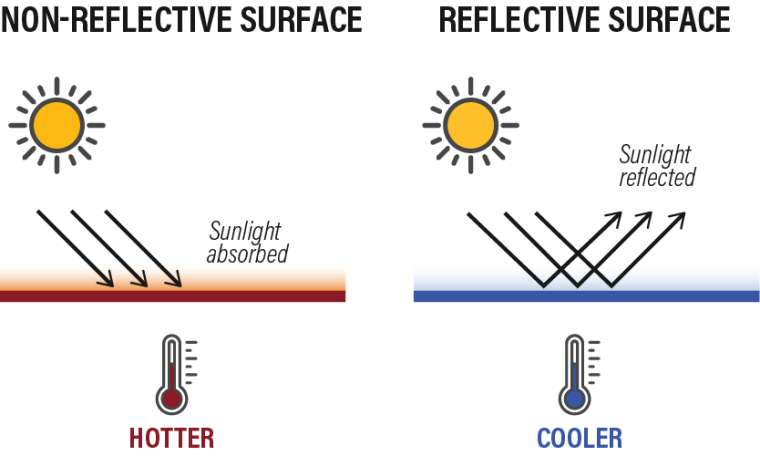
Image Credit: World Resources Institute
Many conventional roofs are also made of asphalt and heat up quickly in sunlight, reaching temperatures of 150 °F or more during the summer months. And it is not just concrete and asphalt that are to blame. Brick structures contribute to urban heat by releasing 51% more heat than structures built of granite. Impervious surfaces contribute to higher temperatures by trapping heat and preventing air and water flow that could help to lower temperatures. And dark surfaces on building exteriors, roofs, and roadways contribute to the Urban Heat Island effect by absorbing solar energy and releasing it into the environment as heat.
Building Codes/Zoning Standards
In the United States, most development decisions occur at the local level. Zoning ordinances, master plans, and neighborhood plans form the framework that dictates what can be built and where. According to Joseph Mendonca with Smart Growth America, these plans are often outdated and tend to prioritize “separated land uses, large lot single-family development, and auto-oriented development”. This type of sprawling development exacerbates the Urban Heat Island effect because it requires more roads and paved surfaces to be built, increasing the number of impervious and heat-releasing surfaces, and requires people to drive more and take longer trips, increasing the amount of vehicle emissions.
Redlining & Investment/Disinvestment
Redlining, which describes the process of restrictive lending that began in the 1930s and limited where racial and ethnic minorities could purchase homes, resulted in a cycle of disinvestment throughout many US cities, the effects of which are still felt today. Redlining led to some of the urban design and development decisions that have left certain city neighborhoods covered in roadways, buildings, and industrial plants, while disinvestment resulted in those same neighborhoods being devoid of parkland, tree canopy, and heat-mitigating construction options.
Mendonca noted that in addition to reducing green space and increasing the number of roads and buildings in formerly redlined communities, redlining and the disinvestment that followed left many of these roads and buildings outdated, energy inefficient, and in need of repair. Older homes and office buildings that are less energy efficient require more electricity to run HVAC systems and release more emissions than newer and more energy-efficient buildings, both of which contribute to increasing urban warming and exacerbating the Urban Heat Island effect.
As global temperatures continue to rise, it is imperative to understand the link between extreme heat and the decisions we make regarding what to build, where to build it, and what to build it with.
Beyond our building choices, however, we will also need to reckon with the role that redlining and disinvestment have played in exacerbating the Urban Heat Island effect by creating conditions in which the heat burden falls disproportionately on certain people and certain neighborhoods within the larger city.
Who is Most Impacted by Urban Heat
Overall, the groups that are most impacted by the Urban Heat Island effect are low-income communities and communities of color. Multiple studies have shown that across the United States, the poorest communities within cities and those with the greatest number of Black, Hispanic, and Asian populations are significantly hotter than adjacent neighborhoods with higher incomes and a larger share of White residents. These temperature variations between urban areas have been persistent, regardless of city age, size, or location, and they are only getting worse. According to researchers, between 1990 and 2020, most cities saw socioeconomic disparities in urban heat exposure increase, as wealthier neighborhoods with predominantly White populations continued to experience significantly cooler temperatures than adjacent neighborhoods with lower-income populations and larger numbers of non-White residents.
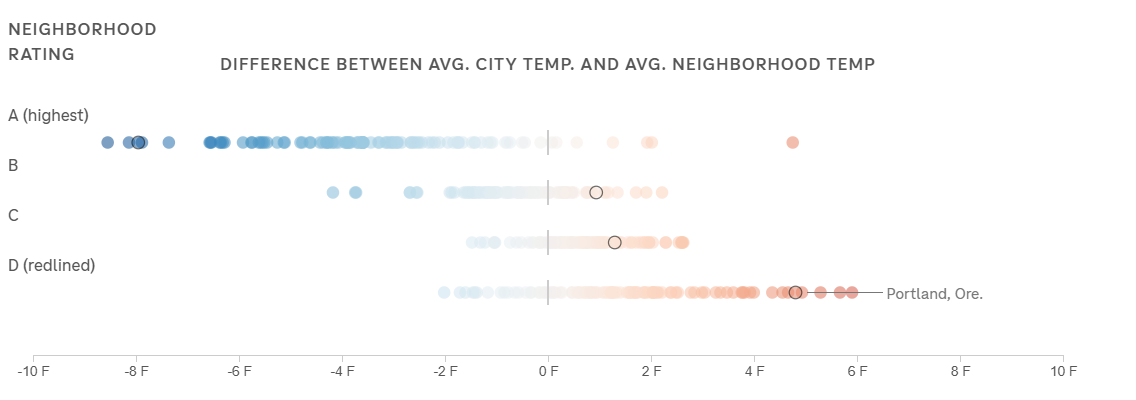
Image Credit: Sean McMinn/NPR
One of the factors that led to these vast temperature disparities between neighborhoods was redlining. Buildings, roadways, and industrial sites were concentrated in lower-income and minority neighborhoods based upon redlining maps, and at the same time, these neighborhoods were stripped of their tree canopy, green spaces, and pervious surfaces like grassland. As a result, formerly redlined communities have been found to be hotter than adjacent non-redlined neighborhoods by up to 13 degrees.
Anyone living or spending time in the city may be impacted by the Urban Heat Island effect, but the research shows that the greatest heat burden continues to fall disproportionately on poorer people, people of color, and those living in formerly redlined areas.
The Future
According to the UN, more than 100 cities around the world experience 5 days or more with temperatures above 50 °C (122 °F) each year – something that was unheard of until recently. As the climate warms, the number of cities experiencing extreme heat will also continue to rise. Currently, the UN projects that a 2 °C increase in global temperature will raise that number by 50, while a 3 °C increase will more than double that number, with estimates that 250 cities across the planet will have 5 days or more with temperatures exceeding 122 °F.
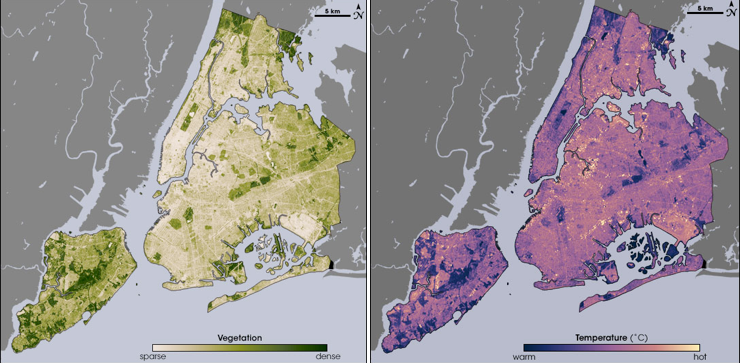
These images from the NASA/USGS satellite Landsat show the cooling effects of plants on New York City’s heat.
Image Credit: Robert Simmon, using data from the Landsat Program
Heat does not impact all city-dwellers equally. Wealthy New Yorkers at the turn of the 20th century may have been able to escape the summer heat by fleeing the city for rural areas, but for most city residents, leaving the city for the summer was not an option. The same holds true today. The good news is that there is a lot we can do to cool our cities just by making different building and developmental choices.
Coming Up…
Urban heat is driven by the built environment, particularly the large number of impervious roadways, dark rooftops, energy-intensive buildings, and heat-absorbing asphalt that are common within cities. As global temperatures continue to rise and cities around the world experience more extreme heat days, rethinking the materials we use to build with may be the answer. In the next article from our Extreme Heat series, “Extreme Heat – Building Differently”, we will examine how green building solutions, historical strategies, and new innovations may be incorporated to lower urban temperatures and limit the Urban Heat Island effect.