Using Technology to Improve Emergency Evacuations
Evacuating large numbers of people is not easy, even under the best of circumstances and even with the most robust planning. There is a lot that can go wrong, from poorly timed evacuation orders to congested roads to gas shortages. And residents who are elderly, disabled, or without access to their own vehicle may find it difficult to evacuate at all. Over the years, emergency evacuations have been studied with the goal of making evacuations safer, more efficient, and more accessible to all. Much of this analysis has focused on improving evacuations through improvements to planning, forecasting, and communication. But what if new technology could hold the key? This is the question a group of researchers from Florida State University sought to answer by investigating the potential for autonomous vehicles to be used in evacuations.
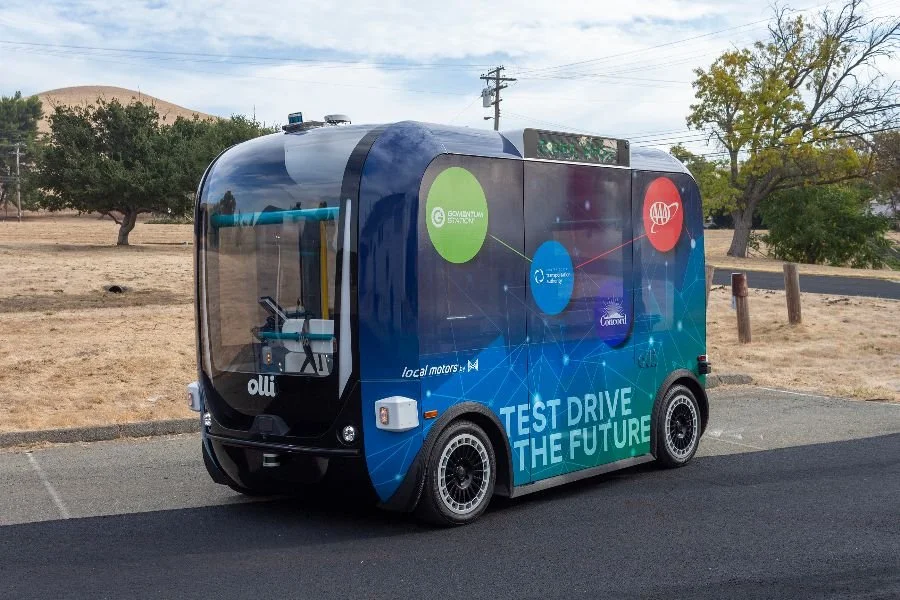
Shared Autonomous Vehicle (SAV); Photo Credit: CCTA
About the Study
To learn more about the role that autonomous vehicle technology could play in making evacuations safer and more efficient, researchers Sevim, Guo, and Ozguven conducted mass evacuation simulations using Shared Autonomous Vehicles (SAVs) with a particular focus on rural areas and vulnerable populations. They selected Sumter County, Florida as their case study for the model and assumed a baseline evacuation scenario that consisted solely of passenger cars. Next, the team ran simulations across 7 evacuation scenarios, from 20% SAV integration incrementally up to 100% SAV integration.
For their simulations, the team configured the SAVs to evaluate routes every 60 seconds to find the most optimal route based on real-time road and traffic conditions, and then to reroute accordingly. After running evacuation simulations through the different scenarios of increasing SAV integration, the researchers found that overall, the higher the integration of SAVs, the more significant the improvements to congestion, traffic distribution, and traffic flow. More specifically, Sevim et al. reported that as the percentage of SAVs to passenger cars increases, evacuation timespans decrease, traffic is distributed more effectively, and congestion remains more stable, with fewer and lower peaks.
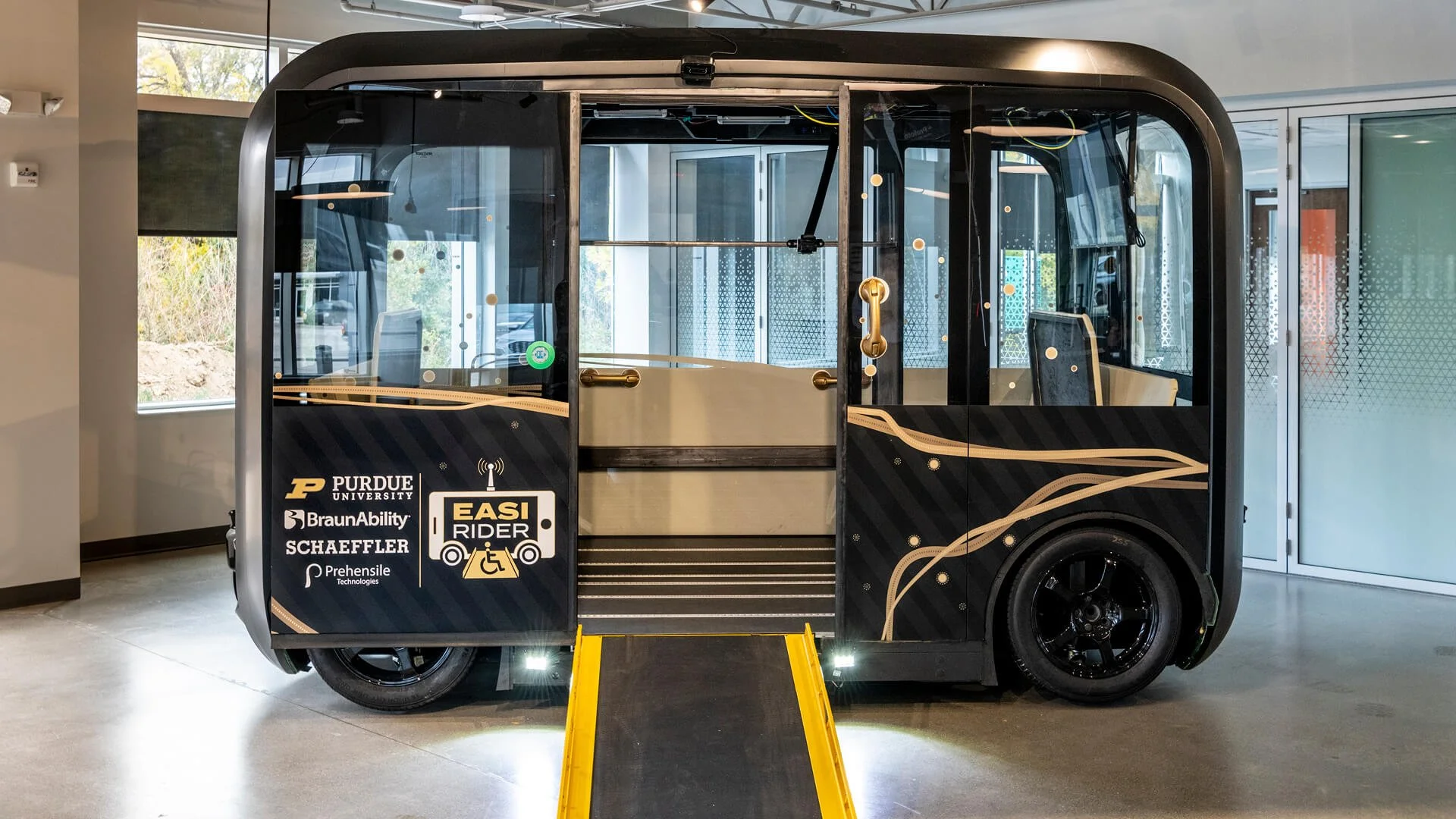
Prototype for the EASI RIDER, Purdue University; Photo Credit: John Underwood
Along with the technological benefits of SAVs, there are other features of SAVs that may make them particularly helpful with evacuating vulnerable populations. For example, SAVs can be equipped to be wheelchair accessible, providing a safe method of evacuation for the elderly and those with disabilities. In addition, SAV pickups can be programmed to provide door-to-door service, enabling those who are homebound or lack transportation to be picked up at locations close to their homes and safely transported out of danger. This function may also help to reduce overcrowding at shelters or uncertainty about where people will go as the destination shelter can be pre-arranged. And finally, because evacuations are often long and evacuees tend to be stressed, scared, and overtired, SAVs may even help to reduce crashes during the evacuation by eliminating the human factor.
Limitations of the Study
Although their research revealed some promising ways that automated vehicles could be used to make emergency evacuations safer, more accessible, and more efficient, Sevim et al. conceded that there are a couple of limitations to their study that make real-world application less likely, at least in the short-term. First, automated vehicle technology is still in its early days and will require both regulatory approval and greater public acceptance before SAVs can be considered a viable option for evacuations. This means that although there may be theoretical benefits to utilizing SAVs in mass evacuation scenarios, until the technology has had a chance to advance more, these benefits only exist on paper.
The second limitation of this study is that it was based on several assumptions that may not be realistic, particularly in a disaster situation. Specifically, the simulations were built off the assumptions that all SAVs would be able to accommodate an average of 25 people, that SAVs would be immediately available in the affected area, that there would be no restrictions to the fleet size, and that all pickup locations would be ideally placed. This means that for SAVs to be most effective at improving evacuations, everything would have to be perfect – the vehicles would have to be the perfect size, they would have to always be available, there would have to be as many SAVs in the fleet as needed, and they would have to pick people up at the exact right places. Given the potential cost of purchasing a fleet of SAVs and the complicated logistics of managing, maintaining, and storing a fleet of SAVs that could be ready to deploy in the event of an emergency, it seems unlikely that this will be a viable option for most cities or municipalities.
Real-World Takeaways
As the researchers highlighted, one of the most beneficial features of SAVs in mass evacuations is their ability to reroute based on real-time traffic conditions. This technology already exists to a certain extent in the form of mapping apps such as Apple Maps and Waze. Future research on this topic should investigate the potential for existing technology to be adapted for use in emergency evacuations. For example, researchers could analyze whether providing each personal vehicle with the same capability as the simulated SAVs to reroute based on real-time conditions would garner similar improvements to traffic flow and congestion.

Because this is a new and evolving technology, it is impossible to know whether SAVs will one day be a viable option to evacuate large numbers of people safely and efficiently. Beyond the needs for technological advances and regulatory approval, there will still be the question of public buy-in. Will people feel comfortable using SAVs? Will they be willing to leave their own vehicles behind? Will they be able to bring their pets? And then there is the question of cost, storage, and simply the logistics behind having a fleet of automated vehicles perpetually on standby.
While SAVs may not be the solution in and of themselves, it is good to see that attention is being focused on ways to make mass evacuations safer, more accessible, and more efficient. And if nothing else, this study provides an interesting glimpse at another way of doing things.