Flood Prevention – How Spillways Help Control Water Flow
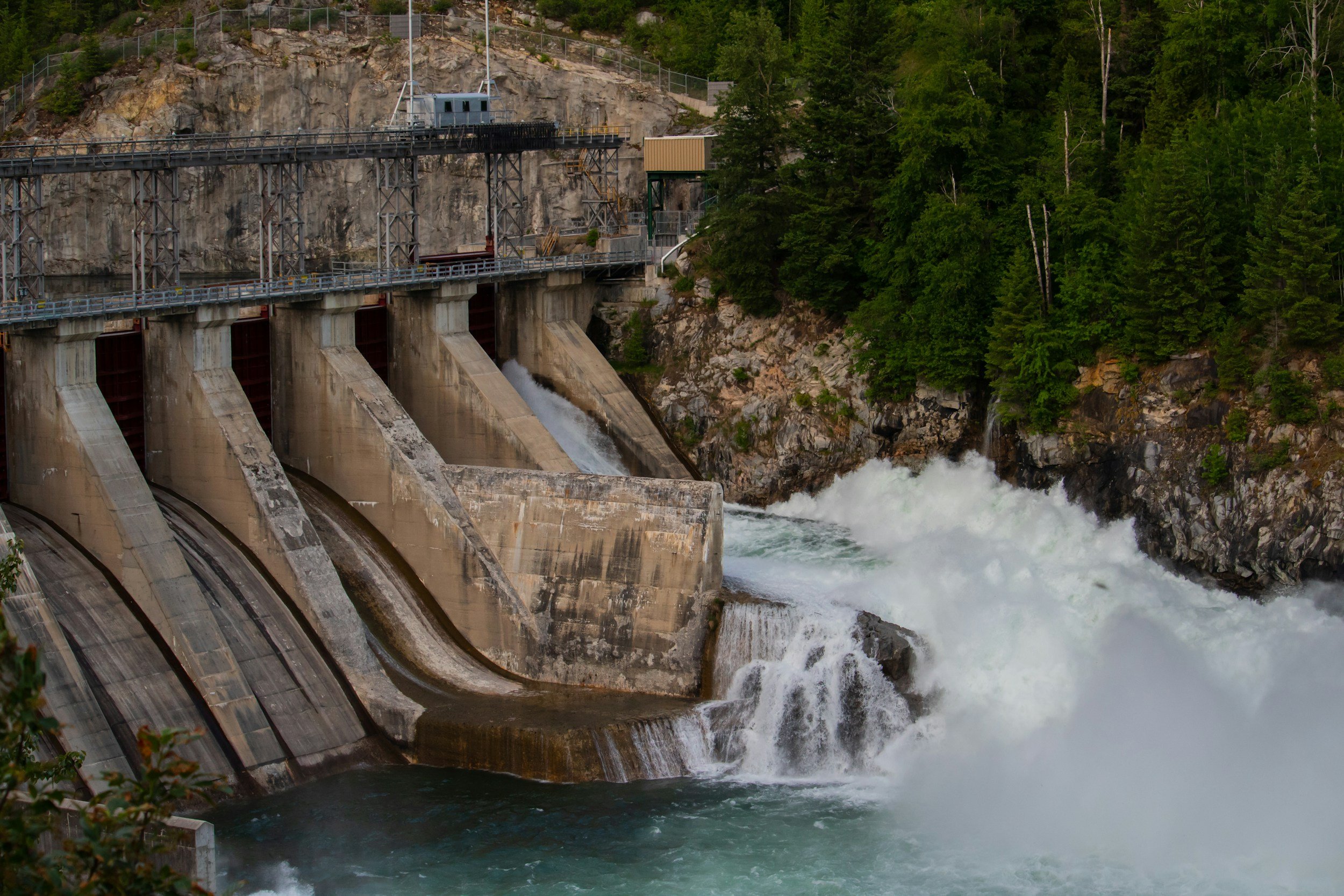
Example of a dam utilizing an overflow spillway to discharge excess water
When most people think of dams, they usually imagine a large structure holding back a substantial reservoir of water. While dams are primarily used to block water, that water can be used in a variety of ways – as drinking water for a local community, for recreational purposes, for agricultural use, or as a renewable energy source in the form of hydropower.
But what happens when the water in that reservoir increases beyond the dam’s capacity? That’s where spillways come into play. An often-overlooked engineering marvel, spillways perform a vital role in flood control and are enormously important to the safety of the communities and citizens located downstream from a dam.
What are spillways?
Spillways are structures within a dam that enable the discharge of excess water, usually through a basic concrete chute. There are many different types of spillways (which we’ll review in a moment), but the spillway itself can be as simple or as complex as the design demands.
Most large dams have at least two spillways – one is for regular use when excess water from the dam’s reservoir needs to be released (this is called the “principal” or “service” spillway). The other spillway is called the auxiliary or emergency spillway, which is utilized only when the dam is at risk of failing and/or a larger amount of water must be released.
How do spillways work?
The best way to think about how a spillway works is to imagine a simple bathroom sink with a primary drain at the bottom of the basin and a secondary drain closer to the top. That secondary drain near the rim of the sink acts as a type of spillway. If the primary drain is unable to discharge water because it is closed, covered, or clogged, water will continue to fill the sink until it gets to the secondary drain which releases the excess water and keeps the sink from overflowing.
All spillways work in a similar manner to that secondary drain in your sink – the spillway releases water once it reaches a certain level to keep the reservoir behind the dam from filling beyond a certain point or overflowing. However, there is one other element to consider with spillways and their roles in dam safety: the spillway must discharge the water in a strategic manner to ensure minimal impact downstream. Simply releasing excess water directly could have drastic consequences and even lead to an eventual dam failure. This is why the design of the spillway is important and why there are so many different types of spillways, from simple to complex.
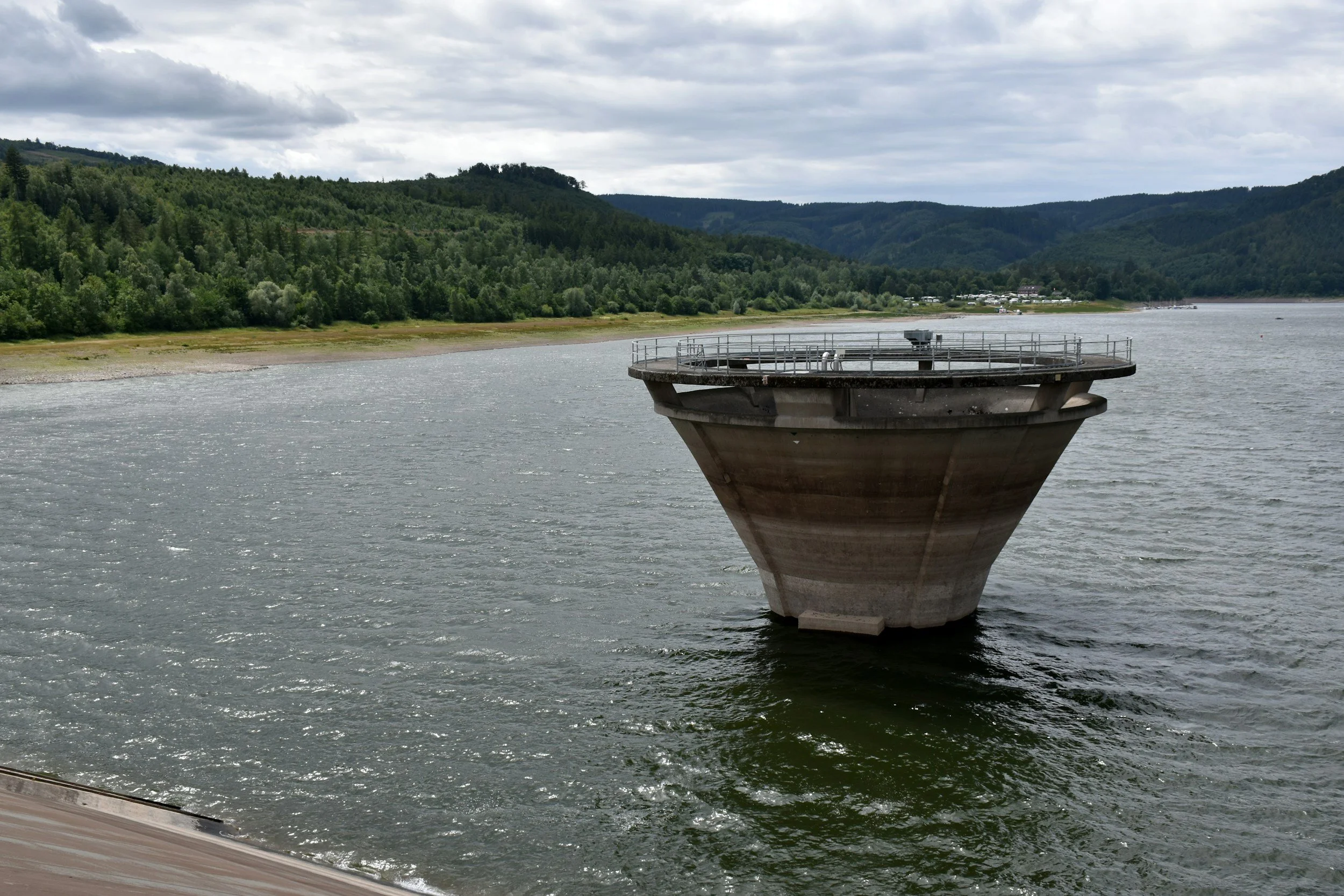
Example of a morning glory spillway that is currently not in use
Types of Spillways
There are eight types of spillways that make up the vast majority of designs used in modern dams. The best choice for a specific type of dam often depends on that dam’s particular operational needs, foundation requirements, and the surrounding topography.
Overflow (also known as an Ogee Spillway)
An overflow spillway has an ogee-shaped (S-shaped) curved profile which reduces the force of the water being discharged. This design offers higher discharge efficiency while reducing the risk of downstream erosion by dissipating the energy of the water being released via its curved slope. However, to be fully effective, an overflow spillway must be carefully designed and implemented. Inaccurate calculation of discharge rate or curvature can undermine the benefits it offers.
Chute (also known as an Open Channel Spillway)
A chute spillway uses a very basic design to transfer excess water downstream. Usually placed adjacent to the main dam structure, chute spillways use an open channel to carry water and need adequate space to work properly. These types of spillways require a solid rock foundation along with regular monitoring and maintenance, as they can become obstructed or erode over time.
Side Channel Spillway
Side channel spillways offer many benefits and can be used in a wide variety of dam designs. A side channel spillway operates by allowing water to spill over the crest of a parallel trough before turning roughly 90 degrees and flowing into a main chute or tunnel. These types of spillways boast the capacity to discharge large volumes of water and can be utilized in narrow canyons or steep hillsides where space is at a premium.
Shaft (also known as a Bell-Mouth or Morning Glory Spillway)
Possibly the most famous type of spillway because of its distinctive look, a morning glory spillway is a type of uncontrolled spillway with no moving parts. It is simply a vertical shaft placed in the reservoir that takes in excess water once the reservoir level reaches a certain point. Shaft spillways are often used when there is not enough space surrounding the dam to allow for other spillway designs.
Labyrinth Spillway
A labyrinth spillway builds upon the basic idea of side channel spillway, using a series of switchbacks to create a zigzag pattern that increases discharge capacity and maximizes reservoir storage. This type of spillway is an excellent choice for sites where widening a spillway is impossible due to space constraints. For this reason, labyrinth spillways are often employed when retrofitting existing dams to pass higher modern probably maximum floods (PMF).
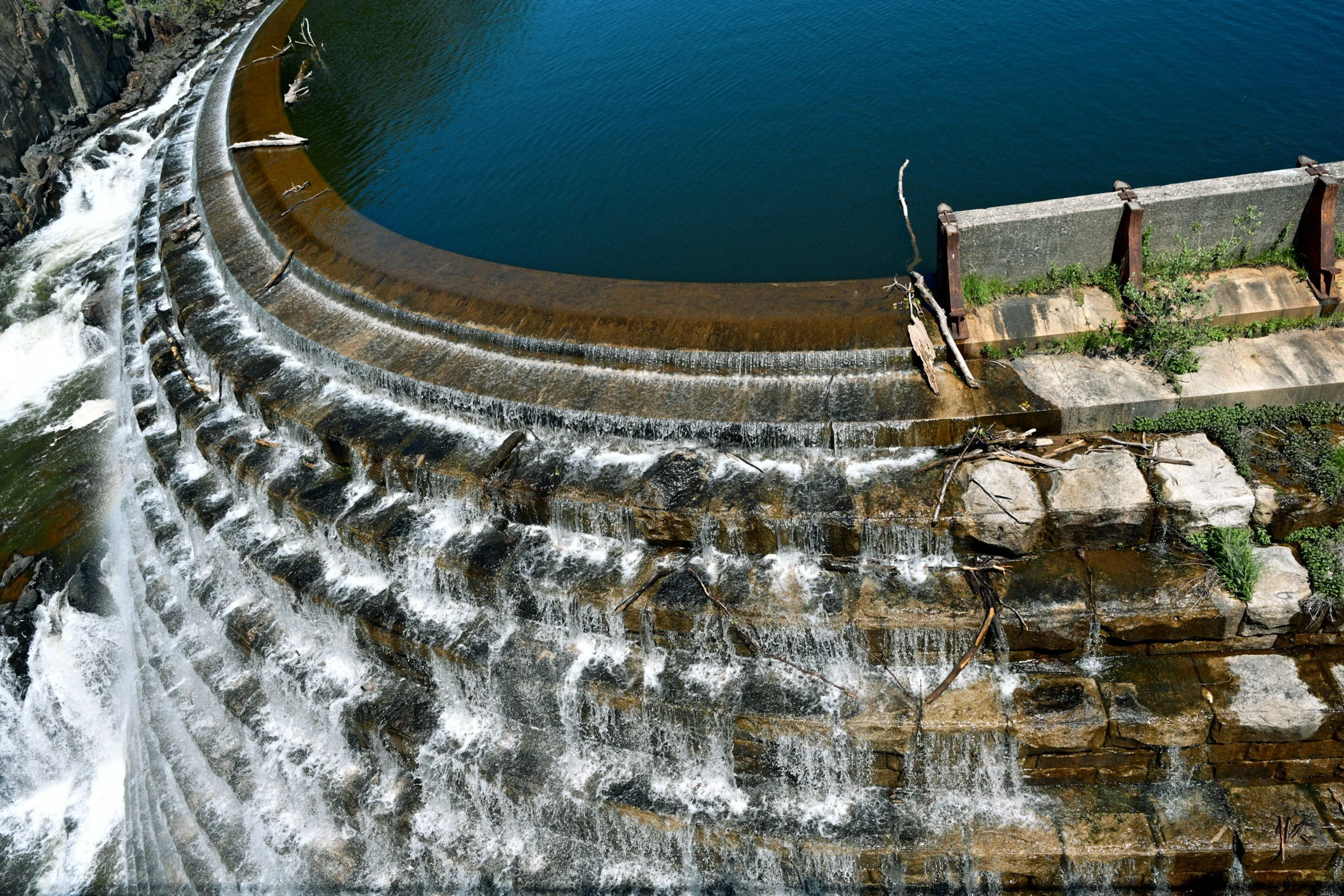
Example of a stepped spillway discharging excess water and carrying branches downstream
Stepped Spillway
A stepped spillway utilizes a structure resembling a staircase to reduce the kinetic energy of the discharged water. Essentially, the steps serve as speed bumps to slow down the water being carried down the chute. Reducing the kinetic energy makes the water less destructive, protecting the lower parts of the dam and reducing the potential for erosion. Additionally, the staircase design helps to trap air bubbles in the water, which improves the health of fish downstream.
Siphon Spillway
Siphon spillways use a more complex design than some of the other examples included on this list, but that complexity allows the system to discharge a large volume of water while maintaining a consistent water level upstream. This design utilizes an inverted U-shaped closed conduit system that leverages gravity to discharge water when it exceeds a specific limit. While it’s able to operate automatically and does not include any moving parts, a siphon spillway can be prone to clogging from floating debris and freezing in winter.
Fuse Plug/Fusegate Spillway
Most spillways are intended as permanent structures, but a fuse plug or fusegate spillway is designed to be destroyed. A fuse plug spillway utilizes an earth or rockfill embankment that acts as a smaller dam, blocking the discharge channel until the water volume behind it overwhelms the “plug,” which is designed to give way and allow the excess water to escape. A fusegate spillway is often designed to maintain its structure during moderate floods, but when water reaches a certain level, the modular blocks that make up the fusegate tip, which enables more water to be discharged. Both of these options are relatively inexpensive to build; however, because they are designed with total destruction in mind, they must be rebuilt after each event, which makes them a poor choice for areas with recurring flooding issues.

Rare gloryhole spillway created by overflow of Lake Berryessa at Monticello Dam, California, March 2017. Source: Wikimedia
The Dangers of Spillways
Although spillways serve a vital role in maintaining dam safety and protecting downstream areas from catastrophic flooding, they also pose their own risks for citizens and wildlife. When spillways are actively discharging excess water, they create strong currents that can draw swimmers or boaters into the channel. If this happens it can be fatal.
When visiting a reservoir for recreational purposes, it’s essential to be aware of the risks that spillways present. Even if a spillway is not currently in action, water releases can be sudden and gates can open without warning, so the best thing to do is steer clear.